About the Project
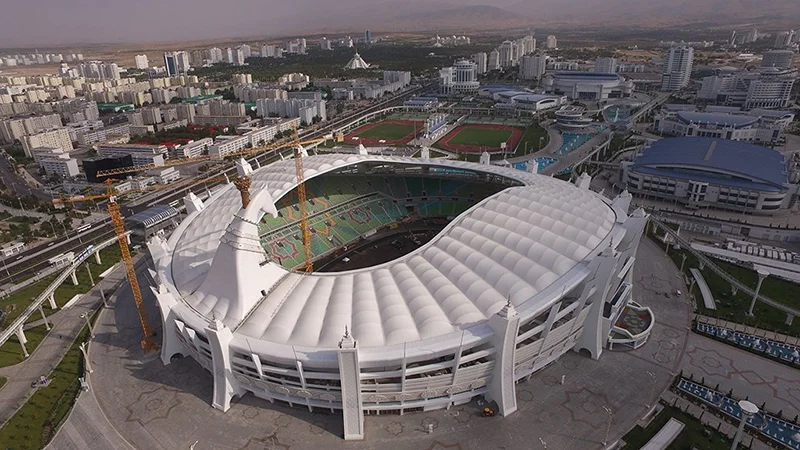
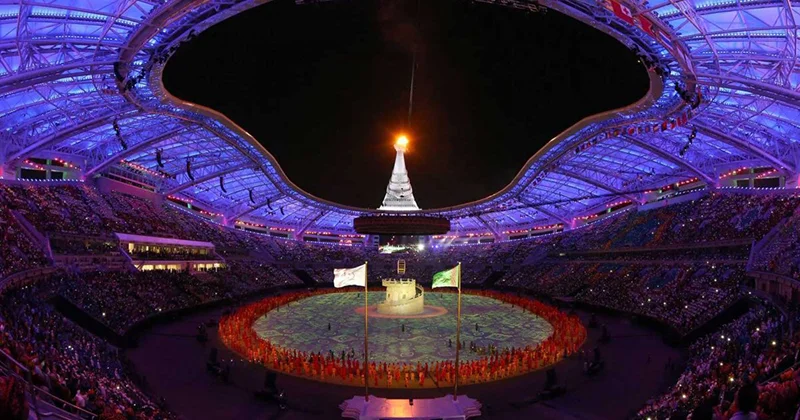
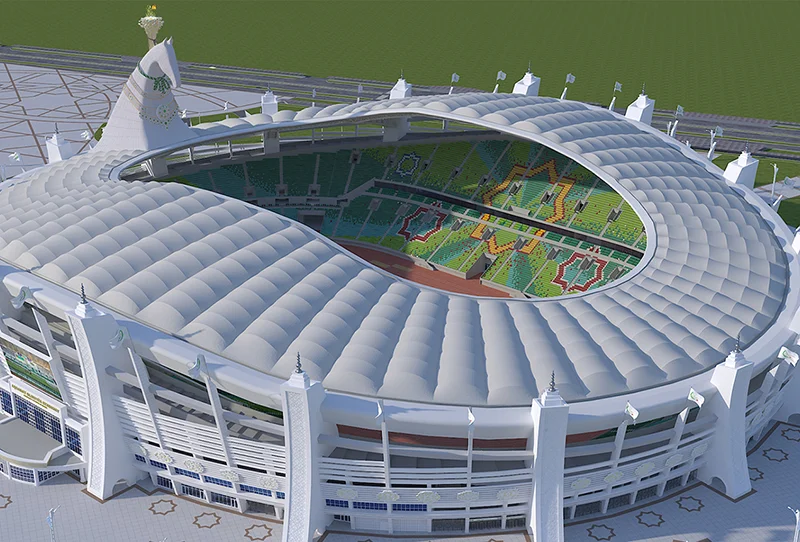
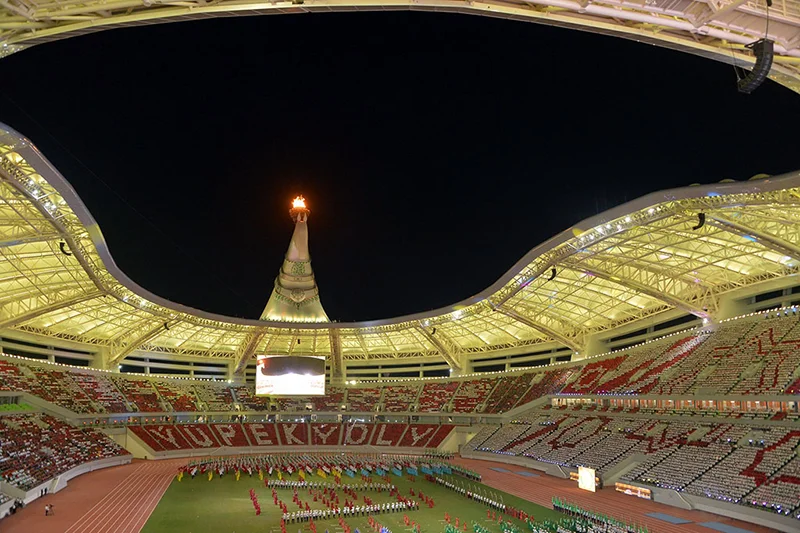
The Ashgabat Olympic Stadium (Saparmurat Turkmenbashy Olympic Stadium), located in Ashgabat, Turkmenistan,
stands as the centerpiece of the 157-hectare Ashgabat Olympic Complex. Completely redesigned and rebuilt with
a 45,000-seat capacity and featuring its signature colossal Akhal-Teke horse head crowning the grandstand,
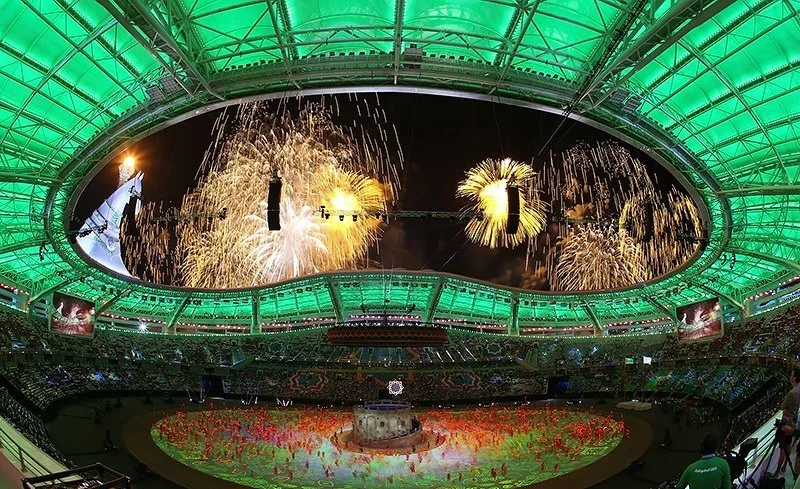
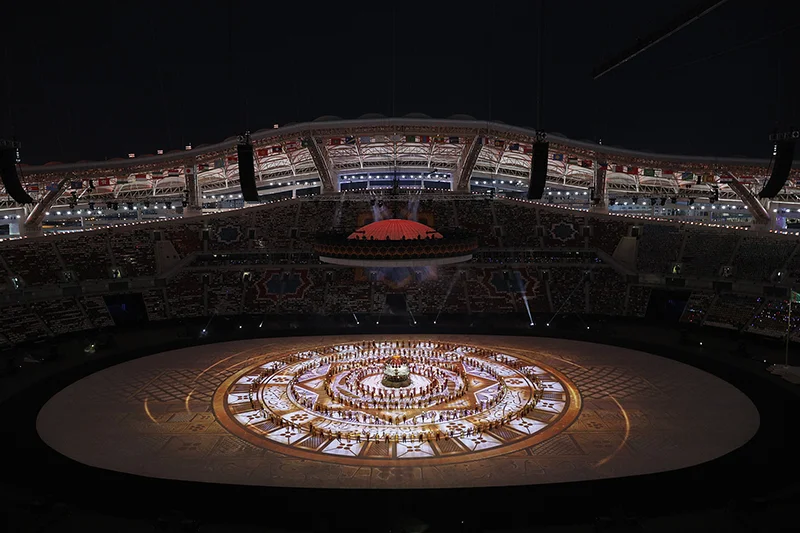
the stadium was engineered to host major international multi-sport events, including the 5th Asian Indoor
and Martial Arts Games (AIMAG).
Project Details
- Project Year: 2017
- Location: Ashgabat / Turkemistan
- Partners: Polimeks
To meet stringent Olympic-level host broadcast requirements, the project incorporated a state-of-the-art
Broadcast Infrastructure & Production System alongside an on-site Test & Measurement (T&M) Laboratory.
This dual-tier technical deployment ensured flawless multi-feed HD/UHD distribution, comprehensive venue
coverage, robust signal routing, and in-house maintenance and calibration capabilities.
WHAT WE DID
1. Project Context & Objectives
Core Technical Mandate:
- Provision of complete end-to-end broadcast connectivity across all arena zones, commentary positions, and Outside Broadcast (OB) van compounds.
- Deployment of centralized Master Control Room (MCR) and Central Equipment Room (CER) routing architectures
- Establishment of an integrated Test & Measurement Lab to guarantee 24/7 signal integrity, component maintenance, and optical/RF link validation.
2. Broadcast Infrastructure & Production Systems
The stadium's broadcast architecture was designed to provide flexible, low-latency, and high-redundancy video and audio distribution across the main arena, media centers, and external broadcast partners.
High-Density Signal Routing & Core Processing
- Matrix Switching: High-capacity baseband SDI and IP-ready core routing switcher handling hundreds of inputs and outputs for 3G-SDI, HD-SDI, and embedded multi-channel audio.
- Signal Processing & Synchronization: Modular frame synchronizers, cross-converters, up/down-converters, and embedders/de-embedders to handle varying video standards from international Rights-Holding Broadcasters (RHBs).
- Multi-Viewing & Monitoring: High-density multi-viewer walls deployed in the MCR, Production Control Rooms (PCR), and Video Operations Center, offering customizable layouts with tally, UMD, audio peak meters, and signal loss alarms.
Production & Live Control Facilities
- Production Switchers: Multi-M/E production switchers with multi-channel DME/effects, redundant power supplies, and dedicated control panels for live event switching and giant screen management.
- Camera Connectivity Backbone: Hybrid SMPTE 311M fiber optic and triax wall boxes distributed strategically around the pitch, athlete tunnels, press conference rooms, and commentary tribunes.
- Audio Systems & Intercom:
- - Digital matrix intercom frame supporting multi-channel panel stations, wireless beltpacks, and two-way radio interfaces for seamless stage manager, director, and technical crew communication.
- - Digital audio mixing console with redundant DSP engines, connected over MADI/Dante networks to field stage boxes.
Broadcast Patching & Distribution
- OB Van Compound Interfaces: High-density custom broadcast termination panels (BTP) equipped with optical CON connectors, HD-SDI BNC patches, XLR audio lines, and triax connections to interface directly with visiting OB vehicles.
- In-Venue Display & IPTV Feed: Integrated feeds feeding the stadium’s massive ribbon boards, giant LED scoreboards, and press area IPTV distribution networks.
3. Test & Measurement (T&M) Laboratory
To ensure ongoing system reliability, continuous signal verification, and localized equipment repair without reliance on overseas servicing, a dedicated Test & Measurement Lab was implemented within the stadium technical facility.
Core Test & Measurement Instrumentation
- Waveform Monitors & Rasterizers: Dual-channel 3G/HD/SD-SDI waveform monitors with eye-pattern and jitter analysis capability to diagnose physical layer signal degradation across long cable runs.
- RF Spectrum Analyzers: Portable and benchtop spectrum analyzers (up to 6 GHz) used for wireless microphone, in-ear monitor (IEM), and SNG/DSNG uplink frequency coordination and interference troubleshooting.
- Optical Time-Domain Reflectometers (OTDR): High-resolution OTDR units and optical power meters dedicated to testing and fault-location on the extensive fiber optic network across the stadium complex.
- Audio & Video Test Signal Generators: Multi-format signal generators providing sync references (Blackburst, Tri-Level Sync), test patterns (Color Bars, Multi-burst), and embedded audio tone sequences.
- Audio Analyzers & Decoders: High-precision audio analyzers capable of measuring THD+N, frequency response, phase delay, and loudness compliance (EBU R128 / ITU BS.1770) for broadcast audio streams.
- Cable & Network Analyzers: Automated handheld network analyzers for Cat6A/Cat7 copper cabling certification and BERT (Bit Error Rate) testers for serial data lines.
Laboratory Workbench & Maintenance Capabilities
- ESD-Protected Workstations: Anti-static ESD-compliant workbenches equipped with temperature-controlled soldering/desoldering stations, digital microscopes, and precision power supplies.
- Calibration & Maintenance Protocols: Automated routines to calibrate camera chains, align CCUs, measure optical insertion loss, and maintain cable assemblies ahead of international events.
4. Technical Architecture Specifications
| Category |
Specification / Component Details |
| Primary Video Formats |
1080p / 1080i / 720p (HD/3G-SDI, IP-ready SMPTE ST 2022 / ST 2110) |
| Audio Infrastructure |
MADI, Dante IP Audio, AES/EBU, Embedded SDI Audio |
| Fiber Network |
Single-Mode Fiber optic ring backbone with Neutrik OpticalCON / SMPTE connectors |
| Intercom System |
High-density Digital Matrix with IP-connected keypanels and multi-channel DECT wireless |
| RF Monitoring Range |
9 kHz to 6 GHz (Covering UHF wireless mics, Wi-Fi, and Satellite C/Ku Bands) |
| Optical Testing |
Dual-wavelength OTDR (1310nm/1550nm) with automated loss measurement |
5. Key Operational Benefits & Project Outcomes
- Host Broadcaster Readiness: The infrastructure successfully supported international broadcast distribution during major games, providing uncompromised feed quality to global rightsholders.
- Zero-Downtime Reliability: Redundant routing, dual power supplies, and fiber ring architecture eliminated single points of failure across the entire transmission chain.
- Rapid On-Site Maintenance: The dedicated T&M Lab enabled engineers to verify fiber links, clear RF spectrum conflicts, and repair cable assemblies on-site within minutes during high-profile live events.
- Future-Proof Asset: Designed with high bandwidth optical pipelines and modular frame topologies, the stadium remains capable of upgrading to native 4K UHD and full SMPTE ST 2110 IP broadcast workflows without major cabling overhauls.